+36 mm48 h rainfall maximum change
+15%relative change in rain maximum
+13.2 m/speak 10 m wind maximum change
PGW vs HISTcomparison basis
The idea
Risk is not a row in a table. It is a place on a map.
Most catastrophe output arrives as a single loss number for a portfolio. That hides the thing a decision actually turns on: where the hazard lands, how far it reaches, and which assets sit inside the footprint.
Atlas is map-first. In the current public sample, Storm Eunice appears as two change-footprint layers: 48 h rainfall and peak 10 m wind. Each compares the historical run with a warming storyline on the same MPAS fields and domain.
The risk map
One storm, two footprints, layer by layer.
This UK Storm Eunice sample compares historical and warming-storyline change footprints. Pick a layer and read the footprint against its scale.
ATLAS · UK SAMPLE
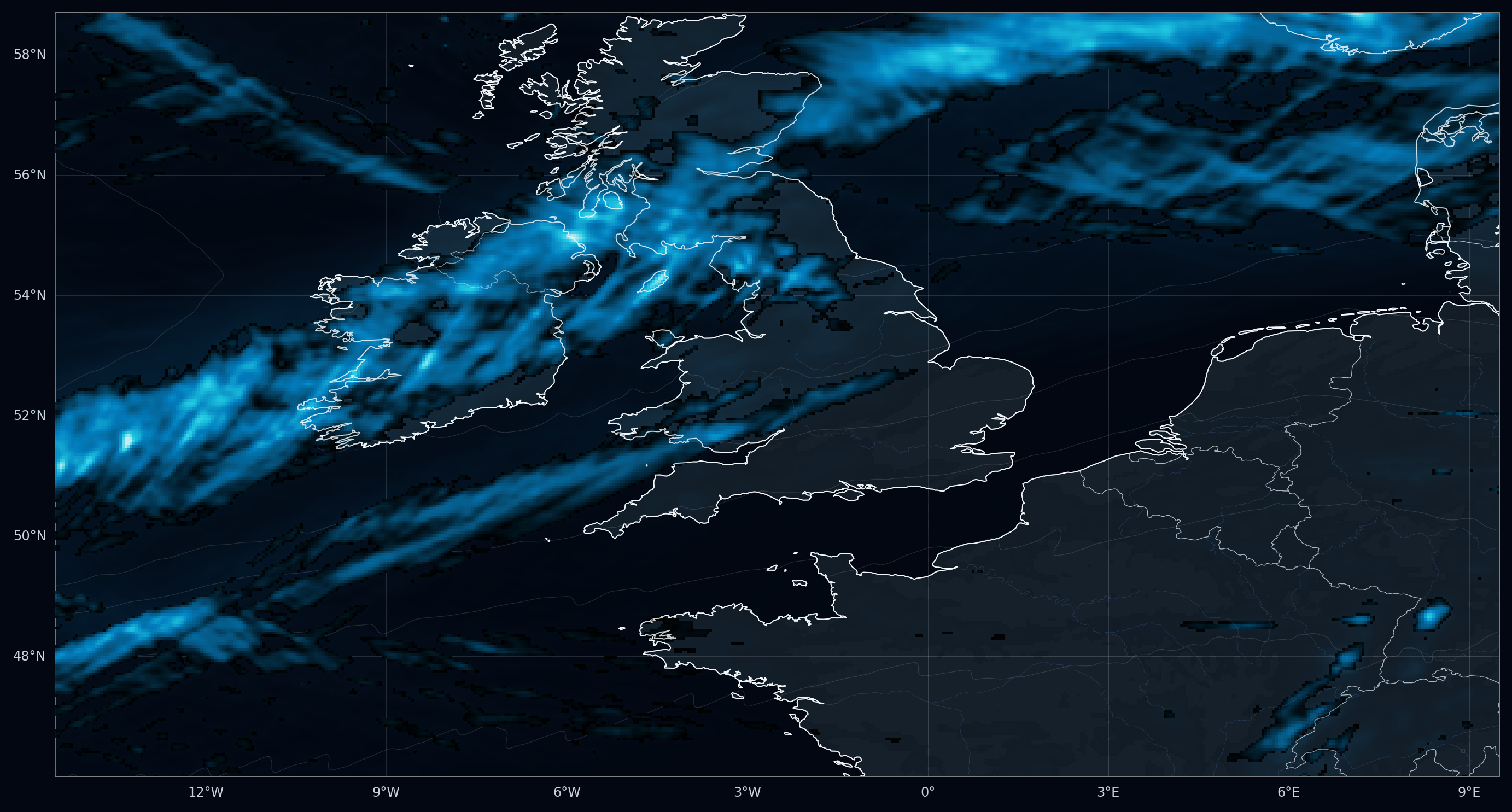
Storm Eunice · 48 h rainfall change
PGW vs HIST
+36 mm
rain maximum +15%
48 h rainfall changemm
+3+8+16+24+30+
+2+4+6+9+
PGW vs HIST change footprints · same MPAS fields, same domain. Public samples are illustrative validation evidence from past storms, not a live hazard service.
From map to readout
Each footprint carries a documented event readout.
The public sample reports only the Eunice values available from the two published footprints. Rainfall carries a maximum absolute change and a relative change in the rain maximum; wind carries the peak 10 m wind change. These are event-footprint values, not per-region or asset-level scores.
// HAZARD READOUTsample Storm Eunice · PGW vs HIST
48 h rainfallmaximum absolute change
Footprint maximum
+36mm
Rain maximumrelative change
Footprint maximum
+15%
Peak 10 m windmaximum change
Footprint maximum
+13.2m/s
Footprint basishistorical and warming storyline
Same MPAS fields, same domain
PGW vs HIST
This public sample presents event-footprint values only. It does not present per-region or asset-level results. Public samples are illustrative validation evidence from past storms, not a live hazard service.
How it runs
From observed storm to a layer on the map.
01
Ingest
Use the historical Storm Eunice event on the current MPAS domain.
02
Simulate
Compare a historical run with its warming storyline under the same setup.
03
Resolve
Compare PGW vs HIST change footprints for 48 h rainfall and peak 10 m wind.
04
Map
Render each change footprint against its documented scale.
05
Read
Read the available event-level values alongside the mapped footprint.
The demo
A narrow public sample. Honest about what is modelled today.
Current sample · Storm EuniceThe public sample maps PGW vs HIST change for 48 h rainfall and peak 10 m wind.
Comparison, not forecastThe public maps compare one past storm under historical and warming storylines. They do not forecast a specific future event.
Also modelledAtlas has also been run on tropical cyclones over the Greater Bay Area.
// note: Atlas currently presents Storm Eunice as two PGW vs HIST change footprints: 48 h rainfall and peak 10 m wind. These are physics-based warming-storyline stress tests of a past storm, not forecasts of a specific future event. Public samples are illustrative validation evidence from past storms, not a live hazard service. Roadmap layers carry no result figures until they are modelled.